
— ZELOCON / Technology / The Graphite Advantage
Low-noise by Design: the graphite advantage.
QUICK ANSWER →
1. Graphite’s Debye temperature is ~2000–2300 K, far above metals.
2. A high Debye temperature (\Theta_D) maintains a small T / \Theta_D ratio, substantially lowering phonon-driven thermal noise at 300 K.
3. This makes low-noise superconductivity at room temperature plausible.
With an exceptionally high Debye temperature, graphite minimizes thermal phonon scattering—preserving coherence and enabling ultra-low-noise operation at 300 K.
— Introduction
Why is critical temperature only half the story?
Critical temperature is only half the story because, in a real device, thermal noise often limits performance more than Tc. Thermal noise is the phonon-driven electron scattering that destroys phase coherence in quantum, sensor and RF components. Here graphite holds a fundamental, often overlooked advantage that follows directly from its Debye temperature.
— The physics
How does the Debye temperature influence thermal noise?
The Debye temperature (\Theta_D) provides a characteristic energy scale for a material’s atomic lattice, set by its bond stiffness and atomic mass. In crystalline solids, it determines how thermal energy is distributed among lattice vibrations (phonons).
In conventional superconductors, Debye temperatures are relatively low—for instance, lead (\Theta_D \approx 105 K) and niobium (\Theta_D \approx 275 K). At room temperature (300 K), T / \Theta_D is large, meaning lattice vibrational modes are heavily populated with thermal phonons. This leads to intense phonon-electron scattering and rapid loss of phase coherence.
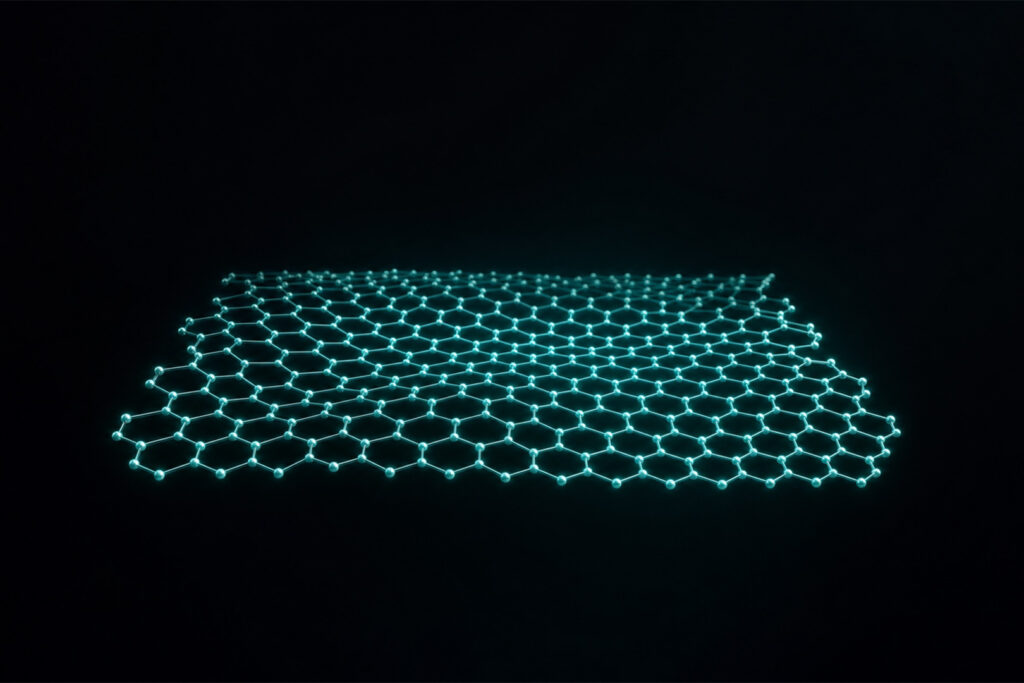
In contrast, graphite’s rigid in-plane sp^2 carbon bonds yield an exceptionally high Debye temperature (\Theta_D \approx 2000 – 2300 K). Because T/\Theta_D remains small even at 300 K, the density of thermally excited phonons is substantially lower than in standard conductors. This suppresses phonon-driven scattering, helping to protect phase coherence and establishing the physical foundation for low-noise performance at room temperature.
— Three physical consequences
What does this mean for coherence?
High Debye temperature protects coherence via three distinct mechanisms: minimized lattice noise coupling, exponentially reduced scattering rates, and high intrinsic structural stiffness.
Decoupling from the lattice
At 300 K, lead behaves classically (Dulong–Petit, effectively “molten”). Graphite remains in the quantum-dominated regime, where the most disruptive high-frequency modes stay largely unpopulated.
Suppressed scattering
High-frequency phonon occupation is suppressed by a factor of e^(−Θ_D/T) — so the electron-phonon scattering rate, the primary noise source for decoherence, is exponentially lower at the same temperature.
Effective stiffness
Covalent sp² bonding gives graphite a structural stiffness that keeps the lattice configuration remarkably stable — preserving the “clean” environment that coherent high-temperature phenomena require.
— Technical profile
What are the key technical parameters of the ZELOCON material?
Material
Temperatur
At 300 k
Phonon energy
Lead (Pb)
≈ 86 K
≈ 3.5
Very high
Niobium (Nb)
≈ 275 K
≈ 1.1
High
Graphite (in-plane)
≈ 2000–2300 K
≈ 0.13–0.15
Orders of magnitude lower
Table 2 — Relative phonon energy follows the Debye scaling U ∝ T⁴/Θ_D³ in the low-temperature limit; an order-of-magnitude representation, not a single measured quantity. Recommended schema: Dataset.
— At the device level
What does the graphite advantage mean for real devices?
For real devices, the graphite advantage means a Josephson junction, SQUID or single-photon detector could show intrinsically low thermal noise even at room temperature — because noise and decoherence are governed by the ratio T/Θ_D, not by T alone. This is what makes low-noise superconducting microelectronics at room temperature physically plausible rather than merely thermally possible.
DATA NOTE →
The Debye advantage complements mastery of barrier and interface quality for reproducible weak links — it does not replace it (see Devices).
— Frequently asked questions
Frequently asked questions about the graphite advantage
What is the Debye temperature of graphite?
Graphite’s in-plane Debye temperature is approximately 2000–2300 K, among the highest of any solid, thanks to its stiff covalent sp² lattice.
Why does a high Debye temperature reduce noise?
A high Debye temperature keeps the ratio T/Θ_D small, so high-frequency phonons stay largely unpopulated and electron-phonon scattering — the main noise source — is exponentially suppressed.
From physics to device
Five device families show where the graphite platform could bring superconducting function out of the cryogenic niche.